
Accepting InstaPay and Fawry payments through your QR menu
Ordering and paying are two separate pipes. How to connect a QR menu to InstaPay, Fawry, cards and cash in Egypt without screenshot fraud, lost change or a messy close.
Menyo Team
July 11, 2026
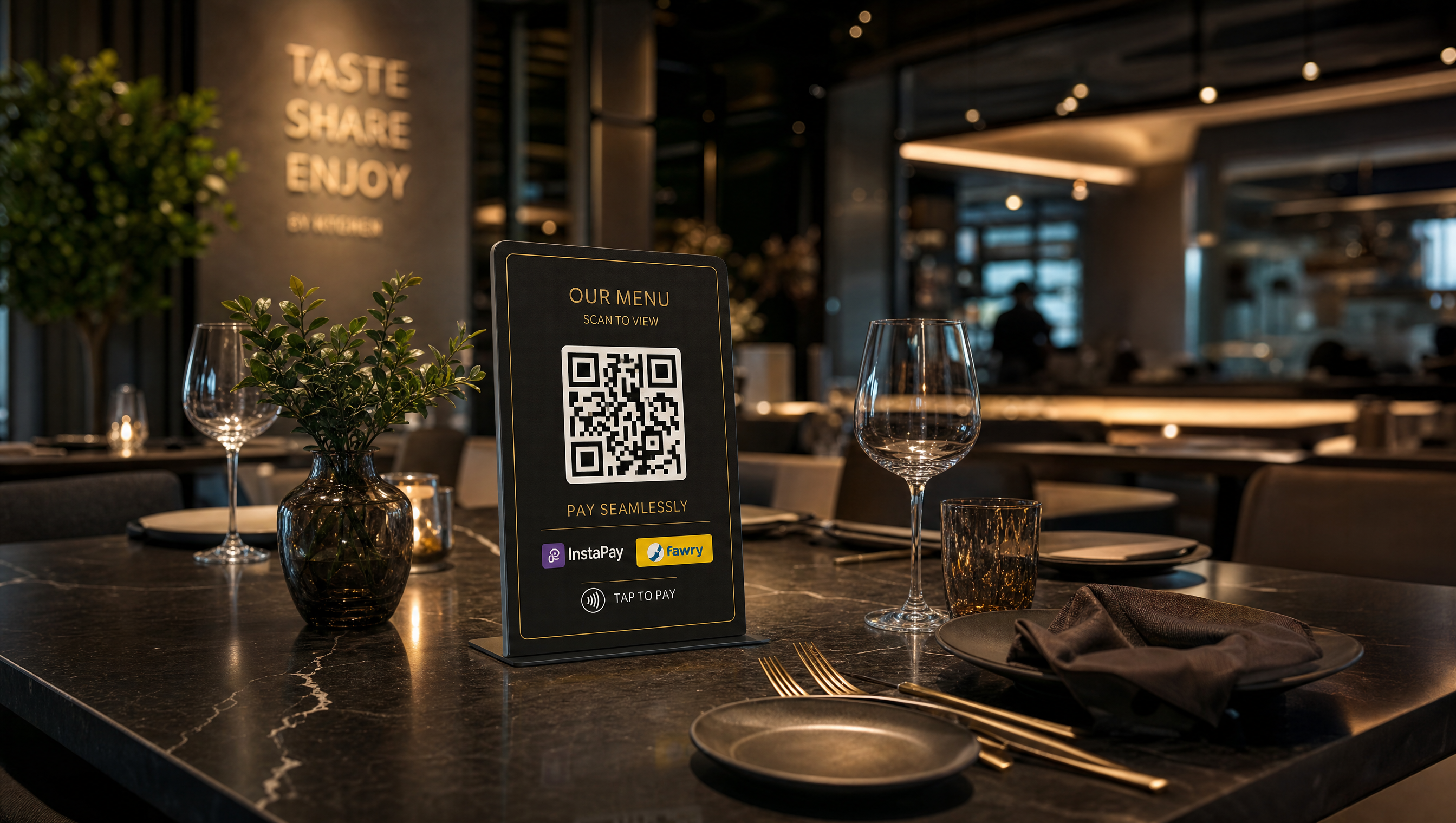
Your guests order from a QR code in two minutes, then wait fifteen for the bill, and the table argues over who has change for a 200-pound note. The ordering side of many Egyptian restaurants has gone digital. The paying side often still runs on cash, a card machine that cannot find a signal, and InstaPay screenshots that nobody checks.
This guide treats ordering and paying as two separate pipes and shows how to join them properly. You will get a plain comparison of cash, cards, InstaPay, wallets and Fawry for a restaurant, a way to choose between paying at the counter and at the table, a routine for split bills, the checks that stop screenshot fraud, and an end-of-day reconciliation that takes ten minutes.
One honest note up front: most QR menu platforms, Menyo included, do not process InstaPay or Fawry inside the guest's menu. The menu handles the order. Payment is taken by your staff or your payment provider, and recorded in your POS. That is usually the more reliable setup anyway.
1The payment rails a restaurant in Egypt can use
| Method | Best moment to use it | What to ask your provider | Main risk |
|---|---|---|---|
| Cash | Anywhere, still expected by many guests | Nothing, but plan your change float | Counting errors, no change, theft |
| Card terminal (including Meeza cards) | At the table or counter | Fee per transaction, settlement time, rental cost, connectivity | Terminal offline at peak time |
| InstaPay | At the counter or table, and for deposits | Whether your business account can receive it, how you are notified, any fees | Fake screenshots, transfers you cannot match to an order |
| Mobile wallets | Guests without cards or InstaPay | Business wallet account, limits, fees | Same matching problem as InstaPay |
| Fawry | Prepaid orders, catering deposits, event bookings | Which Fawry merchant products fit you and how reference codes are issued | Slower for walk-in dining |
| Payment gateway link (from a local gateway provider) | Delivery prepay, deposits, remote orders | Which methods the link supports (cards, wallets, sometimes InstaPay), fees, payout timing | Guests abandoning a long checkout |
Fees, limits and features change, and they differ between banks and providers, so get the current terms in writing before you print anything on a table.
2Choose where payment happens
The right answer depends on your service model, not on which technology is newest.
Pay at the counter, before or after eating
Cafés, juice bars and quick-service places: the guest orders from the QR menu or the counter, pays at the till, and collects or is served. One card terminal and one InstaPay receiving point, both at the till, where a cashier can confirm every payment. Simple, low fraud risk.
Pay at the table after the meal
Full-service restaurants: guests order from the table QR, food goes to the kitchen, and the bill comes at the end. The waiter brings a card terminal or shows the InstaPay details, and the payment is confirmed before the table leaves. This keeps the familiar rhythm of a meal. For more on how much service to keep with QR ordering, read QR ordering versus table service.
Pay before cooking
Delivery, pre-orders for pickup, and catering: send a payment link or a Fawry reference and start cooking only once payment is confirmed. It removes no-shows and fake delivery orders, at the cost of some guests who would rather pay the rider in cash.
3Setting up InstaPay properly
- Receive into a business account, not a staff member's personal account. Ask your bank how InstaPay works for your business account and what payment address or QR code it gives you.
- Put the receiving details where a staff member can see payments arrive. Usually that is the till, or a card the waiter brings to the table with the bill.
- Ask guests to write the order or table number in the transfer note. Without it, matching three transfers of EGP 450 at 9 pm to three tables becomes guesswork.
- Confirm every payment in your own banking app or notification before the guest leaves.
Mistake: accepting a screenshot of a transfer as proof of payment.
→ Fix: screenshots can be edited or reused. A payment counts only when it appears in your own account or notification. Make this a written rule, and back your staff when a guest objects.
4Where Fawry and payment links fit
Fawry is useful where the guest pays before the service: a catering order, a deposit for a birthday dinner, a Ramadan iftar pre-booking, a large pickup order. The guest pays through a Fawry outlet or app using a reference, and you confirm before preparing. Ask Fawry which of its merchant products suits a restaurant of your size.
Online payment gateways that operate in Egypt can generate a payment link that accepts cards and wallets. Send it on WhatsApp for delivery prepay or event deposits. Keep the link specific to one order and one amount so it is easy to reconcile. If catering and events are part of your business, using your menu to drive catering and event sales covers how to package those offers.
5Split bills without the argument
Groups of friends splitting a bill is normal, and it is where payment slows down most. A routine that works:
- Ask at the start, not at the end. "Will this be one bill or separate?" when the table orders.
- Split by items when orders are clearly individual, and evenly when the table shared plates.
- Take each payment separately and confirm each one: one card, then an InstaPay transfer, then cash, each checked before moving on.
- Record each tender separately in the POS, so the close matches.
An illustration of why this matters: a table of six pays EGP 1,800 as one card payment, two InstaPay transfers and three cash contributions. If the waiter records it as "cash EGP 1,800", your cash drawer will be short at close and the bank will show money nobody can explain.
6The ten-minute daily reconciliation
Most revenue that "disappears" in cash-heavy restaurants is not stolen. It is miscounted, mis-recorded or given away in wrong change. A short routine catches it:
Expected cash in drawer = opening float + cash sales recorded in the POS − cash paid out (supplier, petty cash)
- Count the drawer and compare with the formula above. Note any gap.
- Compare the POS card total with the terminal's end-of-day report.
- Compare the POS digital-wallet or InstaPay total with the incoming transfers in your bank app for the day.
- Investigate any gap bigger than your agreed tolerance the same night, while staff remember.
- Every tender type has its own line in the POS
- InstaPay and wallets go into a business account only
- No screenshots accepted as proof
- Change float counted at opening and closing
- Gaps logged daily, not discovered at month end
7Where Menyo fits in this setup
Menyo handles the ordering pipe. Guests order from the table QR, the order reaches the kitchen, and on the Professional plan (USD 99 per month) staff settle it in the POS, recording the payment as card, cash or digital wallet. Tax and service charges are applied automatically to the total, and the sales reports break revenue down by payment method, which makes the reconciliation above much quicker. Menyo does not collect InstaPay or Fawry payments inside the guest's menu. For how the POS side connects to the menu, see the guide to POS integration with QR menus.
8Frequently asked questions
Can guests pay by InstaPay directly from my QR menu?
Not with most QR menu platforms, including Menyo. The practical setup is ordering from the QR menu and paying InstaPay to your business account at the counter or table, confirmed by staff and recorded in the POS.
Should I charge a fee for card or InstaPay payments?
Check your provider's fees and your legal obligations first. Many restaurants build payment costs into menu prices rather than adding surcharges, because surprise charges on the bill cause disputes.
Is Fawry useful for a dine-in restaurant?
Mostly for payments made in advance, like deposits, catering and large pre-orders. For guests paying at the end of a meal, cards, InstaPay and cash are faster.
How do I stop InstaPay fraud?
Receive into a business account, ask for the table or order number in the transfer note, and only accept a payment once it shows in your own account. Never accept a screenshot alone.
How should we handle split bills?
Ask at the start of the meal, split by items or evenly, take and confirm each payment separately, and record each tender on its own line in the POS.
9Two pipes, one close
Let the QR menu do what it is good at, getting the order right, and treat payment as its own disciplined process: a clear place where money is taken, confirmation in your own account, every tender recorded separately, and a short count every night.
Want orders from the table to flow straight into a POS that records every tender? Start a Menyo trial.
Ready to digitize your menu?
Create a beautiful QR menu from a photo in minutes—the AI scan takes about 60 seconds. AI extracts items and prices automatically.
Try Menyo Free